Decades before voters approved a countywide career and technical education millage in 2018, Saginaw Public Schools and regional education leaders were already working to expand vocational training opportunities for students throughout Saginaw County.
Walk through the Saginaw Career Complex today, and you will find students welding metal, programming computers, preparing for medical careers, and caring for animals as part of their agricultural science training. The classrooms and equipment may look considerably different from what they did half a century ago, but the purpose of the programs remains familiar: giving students an opportunity to develop practical skills and explore careers before graduating from high school.
For generations of Saginaw County residents, that experience began at a place they still remember as the Career Opportunities Center, or COC. Today, the facility on Weiss Street is known as the Saginaw Career Complex (SCC), where approximately 1,000 students from across the county participate in career and technical education (CTE) programs each year.
The history of career education in Saginaw County, however, stretches well beyond the facility's current name and the countywide millage approved in 2018. It is a history rooted in Saginaw Public Schools' early commitment to vocational education, the development of a dedicated career training center in the 1970s, and decades of collaboration among school districts seeking to make specialized programs more accessible to students.
Archived editions of The Saginaw News reveal another significant part of that history: Saginaw Public Schools and the Saginaw County Intermediate School District, now known as Saginaw Intermediate School District (ISD), were discussing countywide vocational education funding as early as 1973. Those conversations continued through subsequent decades, long before voters established the dedicated CTE millage that supports the regional system today.
Before 1972: Arthur Hill Technical School and the roots of vocational education
Long before the Saginaw Career Complex opened its doors, Saginaw Public Schools was providing students with opportunities to learn technical and occupational skills through Arthur Hill Technical School and vocational programs within its high schools. Those early offerings reflected the importance of skilled trades and industrial occupations to the Saginaw community, where manufacturing and related industries provided employment for generations of residents.
By the late 1960s, demand for additional vocational opportunities was helping reshape conversations about public education. Traditional academic coursework remained central to the high school experience, but education leaders increasingly recognized the value of specialized training that could prepare students for employment, apprenticeships and additional technical education. Providing that instruction required dedicated facilities, equipment and teachers with occupational expertise, investments that were not always practical for individual high schools to make independently.
Saginaw Public Schools became a driving force behind the development of a centralized vocational education facility that could offer students a broader selection of programs. The district's efforts built upon its existing technical education programs and the work of educators and community leaders who had advocated for practical career preparation.
The result was the Career Opportunities Center, a facility that would become a familiar part of the educational experience for thousands of Saginaw County residents.
1972: The Walter C. Averill Career Opportunities Center opens
In 1972, Saginaw Public Schools opened the Career Opportunities Center on Weiss Street, marking a significant expansion of vocational education in the community. The approximately $3 million facility was formally dedicated that October and became associated with the name of Walter C. Averill Jr., a Saginaw education leader whose contributions to vocational education were recognized through the center's naming.
The new center brought specialized programs together under one roof, providing students with access to equipment, instructors and practical experiences that extended beyond the traditional high school classroom. Saginaw Public Schools owned and operated the facility, establishing an educational institution that would continue evolving over the next five decades.
The approach emphasized learning by doing. Students spent part of their school day developing occupational skills while remaining enrolled in their home high schools, an arrangement that allowed them to explore career interests without abandoning their broader educational requirements. The programs also created opportunities for students to work on projects connected to actual businesses and community needs.
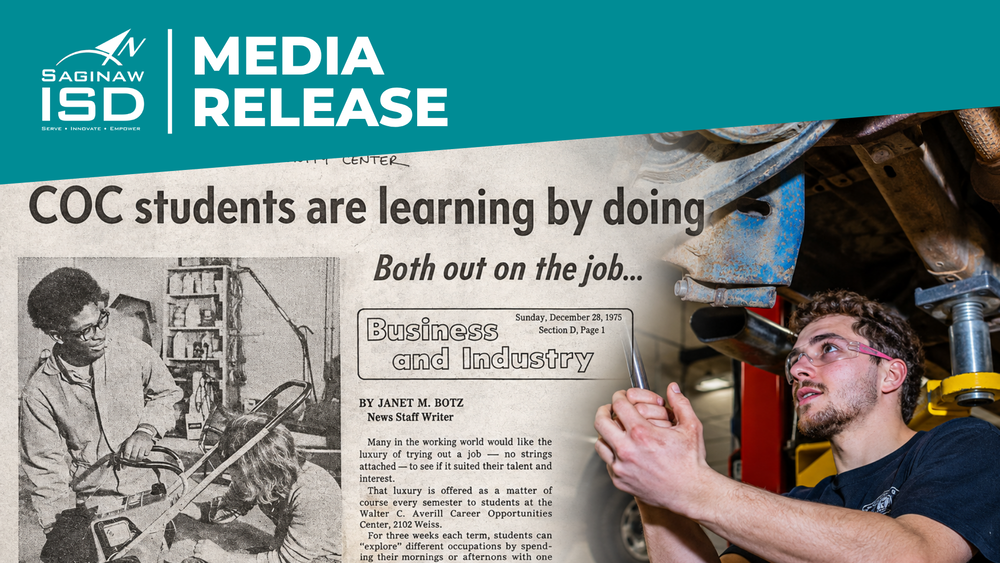
Newspaper coverage from the 1970s offers a glimpse into that early educational environment. In 1974, The Saginaw News reported on a student-operated restaurant at the center, where students prepared and served meals to customers as part of their training. Another article, published in December 1975, highlighted how students were gaining experience through classroom projects and placements with employers.
In May 1978, the newspaper reported that COC students were producing electrical wiring kits for a company involved in a housing project in Saudi Arabia. The assignment illustrated how vocational instruction could connect students in Saginaw with work that extended far beyond the local community.
These experiences helped establish the Career Opportunities Center as more than a collection of vocational classrooms. It became a place where students could apply what they learned, develop professional expectations and gain exposure to the industries they might eventually enter.
1973–1980s: Countywide access and millage discussions begin
Although Saginaw Public Schools had established the Career Opportunities Center, questions about how to make its programs accessible to students throughout Saginaw County emerged almost immediately.
An April 10, 1973, article in The Saginaw News, titled "Vocational School Merger Afoot," documented discussions between Saginaw Public Schools and the Saginaw County Intermediate School District about expanding vocational education through a countywide arrangement. The conversations included the possibility of a property tax millage that could help finance vocational education and reduce the costs borne by individual participating school districts.
The distinction between the two organizations was important even then. Saginaw Public Schools had developed and operated the Career Opportunities Center, while the intermediate school district had a potential role in coordinating and financing vocational education on a broader geographic scale. The newspaper described how a countywide millage could provide a funding mechanism for programs operated by Saginaw Public Schools.
Those early discussions were not the same as the millage eventually approved in 2018, but they demonstrate that the idea of sharing vocational education costs across Saginaw County was being considered more than four decades earlier.
As the Career Opportunities Center developed, students from surrounding districts participated in its programs, but access depended in part on whether their home districts could afford the associated expenses. Tuition and transportation represented real costs, particularly for smaller districts balancing those expenses against other educational priorities.
By the early 1980s, the financial challenges had become more pronounced. A February 14, 1982, Saginaw News article, "Enrollment dip has COC examining tax vote," reported that enrollment at the center had increased from approximately 786 students when it opened to 1,574 in 1979 before declining to about 1,430. The newspaper connected the enrollment concerns to financial pressures facing participating school districts and renewed discussions about a countywide funding proposal.
The article also described the possibility of families paying tuition themselves when their home districts could not cover the cost. For students interested in vocational education, the availability of a program did not necessarily mean their district could afford to send them.
Saginaw Public Schools continued operating the center, while intermediate school district officials and local education leaders considered how a countywide funding arrangement might address those challenges. The discussions reflected a longstanding tension between the regional benefits of specialized vocational programs and the financial responsibilities of individual school districts.
That question would remain relevant for decades: How could Saginaw County maintain a centralized career education facility while ensuring that students from different communities had meaningful opportunities to attend?
1990s–2018: A changing name and an enduring mission
Over the following decades, the Career Opportunities Center adapted its programming to changes in technology, employment and the local economy. Traditional trade programs remained an important part of vocational education, while fields such as health care, business technology and computer networking created new opportunities for students.
The center eventually became known as the Saginaw Career Complex, a name that reflected the broader range of educational and career pathways available to students. Throughout that evolution, Saginaw Public Schools continued to own and operate the facility, maintaining its central role in delivering career education to students from across the county.
The influence of those programs can still be seen in the experiences of former students. When Saginaw ISD recently invited alumni to share their memories of COC on Facebook, responses came from residents who had pursued careers in heating and cooling, manufacturing, education, hospitality, health care and other fields.
Fred Hovis credited his major appliance repair instructor, Chuck Teenier, with providing both technical instruction and mentorship that influenced his career in the HVAC industry. Duane Chrysler recalled how machine shop training helped prepare him for decades of work in skilled trades before he became an instructor himself. Tanisha Jackson Brooks described how the Child Development program contributed to an educational journey that eventually led her to teaching, doctoral studies and educational leadership consulting.
Other alumni described learning skills they continued using at home or in their personal lives, even when they ultimately pursued different occupations. Their experiences illustrate how the value of career education has extended beyond students who entered the specific trade they studied.
As the center's programs evolved, the question of how to finance countywide participation remained. Under the longstanding tuition-based model, school districts sending students to SCC were responsible for costs associated with instruction and transportation. Those expenses could influence participation and the number of students districts were able to enroll.
The arrangement also placed different financial demands on districts depending on their size, resources and student interest in career programs. Although the center served a regional purpose, its funding continued to depend substantially on the budgets and decisions of individual school districts.
By 2018, the Saginaw Career Complex was offering seven career pathways. That year would bring significant changes to the structure and financing of career education throughout Saginaw County.
2018–2026: A countywide millage expands career education
In 2018, Saginaw County voters approved a dedicated one-mill property tax to support career and technical education. The decision established a countywide funding source intended to help participating districts cover eligible CTE tuition and transportation costs, addressing financial concerns similar to those documented in newspaper coverage during the 1970s and 1980s.
The same year, responsibility for the county's Career Education Planning District (CEPD) transitioned from Saginaw Public Schools to Saginaw ISD. The change expanded the intermediate school district's role in regional coordination, program oversight and quality assurance, while Saginaw Public Schools retained ownership and operation of the Saginaw Career Complex.
That division of responsibilities remains central to the partnership today. Saginaw Public Schools operates SCC, employs its educators and delivers the instructional programs. Saginaw ISD serves as the fiscal agent for the countywide millage, administers the restricted CTE funding and coordinates regional career education responsibilities.
Under the current funding model, a participating district such as Merrill Community Schools pays Saginaw Public Schools for eligible tuition associated with students attending SCC. The district can then submit those expenses, along with eligible transportation costs, to Saginaw ISD for reimbursement using CTE millage dollars. The arrangement allows Saginaw Public Schools to continue operating the center while providing a countywide funding mechanism for participating school districts.
Since the millage was approved, the number of programs offered at SCC has increased from seven to 21, while annual enrollment has grown from approximately 490 to 993 students. Programs now span industries including health care, advanced manufacturing, skilled trades, engineering, information technology and animal and agricultural science.
According to information published by Saginaw ISD, more than 6,000 students have participated in countywide CTE opportunities since 2018. Approximately $27 million in eligible tuition and transportation expenses has been reimbursed to local school districts, and more than $9 million has been invested in facilities, infrastructure and instructional equipment.
The growth has involved more than the two organizations responsible for SCC operations and countywide CTE funding. Local school districts continue to connect students with available programs, while businesses and industry partners provide expertise, equipment, career exploration and work-based learning opportunities.
Saginaw Public Schools' longstanding role in delivering vocational education remains foundational to that work. Its partnership with Saginaw ISD represents an evolution of the regional cooperation discussed decades earlier, with the two organizations carrying out distinct responsibilities within a shared career education system.
What's next? Voters to decide on CTE millage renewal and restoration
On November 3, 2026, Saginaw County voters will consider a proposal to renew and restore the countywide career and technical education millage for another 10 years, covering 2028 through 2037. The proposal would renew the currently authorized 0.9962 mills and restore 0.0038 mills reduced through the Headlee Amendment, returning the total to the original one mill approved in 2018. If approved and levied in 2028, the millage is estimated to generate approximately $7.1 million in its first year to support authorized CTE expenses.
The upcoming vote comes more than five decades after Saginaw Public Schools established the Career Opportunities Center and education leaders began discussing how to finance vocational training across district boundaries. From the early programs at Arthur Hill Technical School to the Walter C. Averill Career Opportunities Center and today's Saginaw Career Complex, Saginaw Public Schools has remained a central institution in the development and delivery of career education in Saginaw County. Over time, its collaboration with Saginaw ISD, neighboring school districts and local employers has evolved to meet changing educational needs and workforce demands.
The November 3 renewal and restoration proposal represents the next chapter in that history. Voters will determine whether to continue the dedicated countywide funding structure established in 2018, which supports tuition and transportation reimbursements and other eligible career education investments. The decision follows decades of discussions about how Saginaw County can finance and provide access to specialized career training, a conversation that began long before the current millage existed.
More information about the CTE millage renewal and restoration proposal is available at www.SaginawCountyCTE.com.